Tutorial 1 : Semantic Segmentation
deepvisiontools provides formats, dataset, metrics and models adapted to semantic segmentation. We are going through and exemple explain how you can do this. We recommend that you already had a look at Tutorial 0 : getting started.
Configuration
Everything in deepvisiontools starts with the Configuration class.
[17]:
from deepvisiontools import Configuration

config = Configuration(
    data_type="semantic_mask",
    num_classes=1,
    device="cuda",
    mask_min_size=5,
    semantic_mask_logits_combination="avg",
)
As you can see, you need to provide semantic_mask as data_type. Like for detection tasks, you can choose the device and the num_classes.
IMPORTANT : For semantic segmentation task, be careful with multiclass. Indeed, binary correspond to num class = 1 but for multiclass the background (which must be labelled as 0, but we come to that later) is counted as a class. So if you have 2 targets classes + background please indicate num_classes=3
You can modify the mask_min_size attribute. This will remove all masks that have a pixel number inferior to this value (it might help cleaning a bit the masks or avoid tiny errors in annotations).
Finally, you can choose the way the logits are combined when you add 2 semantic masks. This is important for inference with patchification : In case of overlap, the final result of the overlapping region must derived from 2 different predictions. You can use either avg, min or max.
Dataset, Dataloader
Semantic segmentation in deepvisiontools comes with a default dataset structure :
. Dataset Name
        ├── images
            ├── name01.png
            ├── name02.png
            └── ...
        ├── masks
            ├── name01.png
            ├── name02.png
            └── ...
Note that the extension does not matter (you can have image as png and masks as jpg) as long as they have the same name. The masks must be 1-d channels image-like where the value of each pixel is the actual class of the object (0, 1, 2, …). Tu use this default format, as per detection tasks, simply use the DeepVisionDataset class. Note that the classes can be float or ints as long as they can be converted to int by simply calling a int() (or the equivalent torch dtype) on them!
[18]:
from deepvisiontools import DeepVisionDataset

mydataset = DeepVisionDataset("path/dataset/semantic_binary/train")
The same functions that the one for detection tasks are available. We are going to export the dataset to generate visualizations
[19]:
# mydataset.preprocessing = None  # remember from previous tutorial that if you want to see the image not normalized you need to set this to None.
# mydataset.category_ids = {
#     1: "vegetation"
# }  # we do this to have the actual name in visualization instead of the class number.
# mydataset.export_dataset("exported_dataset")
It will create a new folder containing the images, masks and visualizations. Please note that the masks are by default saved as tif extensions to allow float saving (we use float to avoid problems if dealing with more than 256 classes). The visualizations are generated automatically. (For this tutorial we used the VegAnn dataset available at : https://zenodo.org/records/7636408)
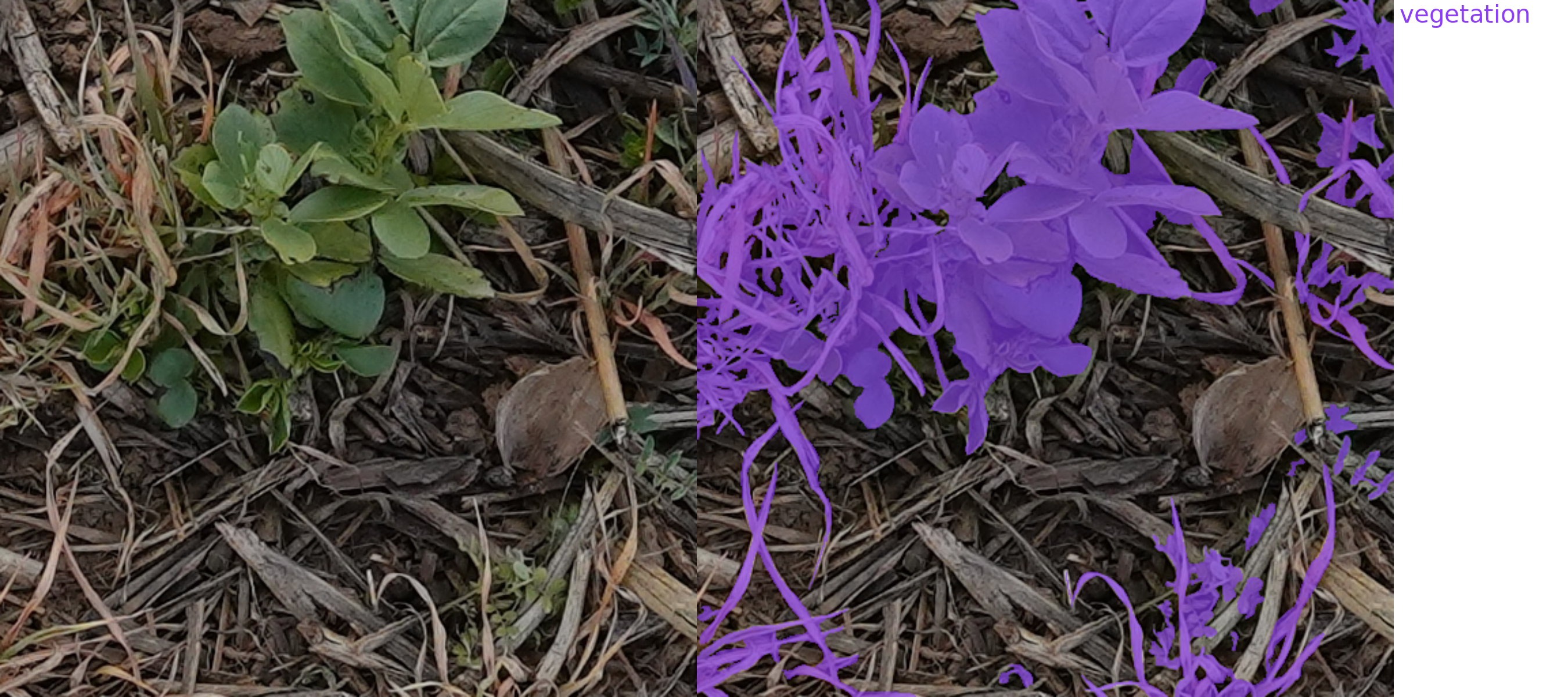
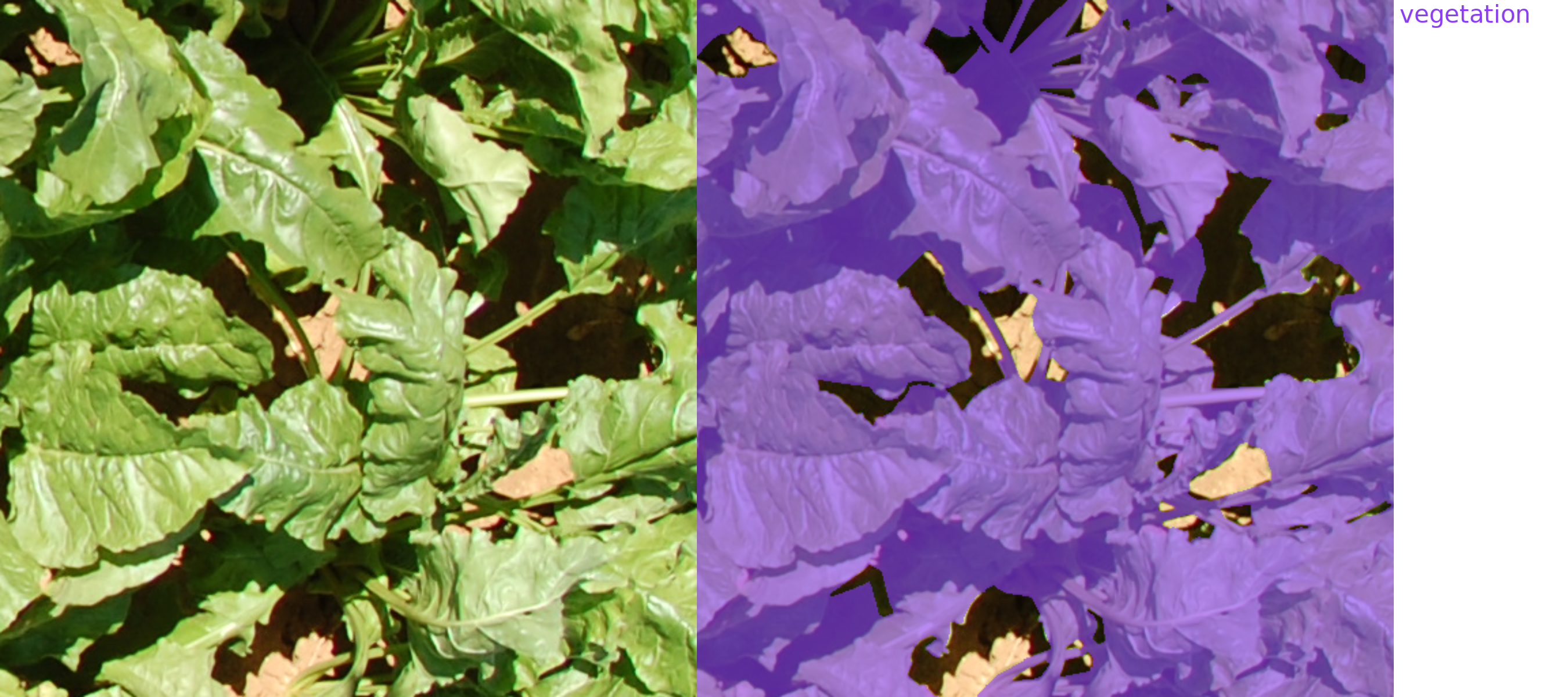
Of course, like most objects in deepvisiontools you can customize your own dataset. But we’ll see that in another tutorial.
Finally, you can add augmentations and wrap everything into a data loader like in the previous tutorial. Here note that we added some builin additional augmentations that are proposed in detectools on top of the ones available in torchvision.transforms.v2
[20]:
from deepvisiontools import DeepVisionLoader
from deepvisiontools.data.additional_augmentations import RandomCropAndResize
from torchvision.transforms.v2 import (
    RandomVerticalFlip,
    RandomHorizontalFlip,
    ColorJitter,
)

augmentations = [
    RandomCropAndResize(256, 512, p=0.1),
    RandomHorizontalFlip(),
    RandomVerticalFlip(),
    ColorJitter(hue=0.1),
]

mydataset = DeepVisionDataset("path/dataset/semantic_binary/train")
train_set, valid_set, test_set = mydataset.split((0.6, 0.2, 0.2))

train_loader = DeepVisionLoader(valid_set, batch_size=4)
valid_loader = DeepVisionLoader(valid_set, batch_size=4)
One word on SemanticMaskFormat : As every target/prediction object in detectools, semantic masks are wrapped into a specific Format called SemanticMaskFormat. This class is quite similar to the BboxFormat or InstanceMaskFormat class with small details : - The number of object is the number of different classes in the target - The labels are just the different classes present in the target - You cannot add directly 2 targets unless they both contains a score value (logit map). The add functionnality is important in inference/patchification and in some particular built-in augmentations.
Other than that they work the same way.
Model, Training and metrics
Semantic segmentation tasks works exactly the same way as detection tasks. You need to use a DeepVisionLoader, and a Trainer class. The implementation would be identical to the first tutorial. Only the metrics that start with “Semantic” in the available metrics are compatible with semantic segmentation tasks.
Currently the models that are available are the full list of segmentation-models-pytorch library (https://github.com/qubvel-org/segmentation_models.pytorch).
To use one simply use the deepvisiontools wrapped
[21]:
from deepvisiontools.models import SMP
import segmentation_models_pytorch as smp

model = SMP(smp.Unet, encoder_name="resnet101", loss=smp.losses.FocalLoss(mode="binary"))
print(model)
_SMP(
  (encoder): ResNetEncoder(
    (conv1): Conv2d(3, 64, kernel_size=(7, 7), stride=(2, 2), padding=(3, 3), bias=False)
    (bn1): BatchNorm2d(64, eps=1e-05, momentum=0.1, affine=True, track_running_stats=True)
    (relu): ReLU(inplace=True)
    (maxpool): MaxPool2d(kernel_size=3, stride=2, padding=1, dilation=1, ceil_mode=False)
    (layer1): Sequential(
      (0): Bottleneck(
        (conv1): Conv2d(64, 64, kernel_size=(1, 1), stride=(1, 1), bias=False)
        (bn1): BatchNorm2d(64, eps=1e-05, momentum=0.1, affine=True, track_running_stats=True)
        (conv2): Conv2d(64, 64, kernel_size=(3, 3), stride=(1, 1), padding=(1, 1), bias=False)
        (bn2): BatchNorm2d(64, eps=1e-05, momentum=0.1, affine=True, track_running_stats=True)
        (conv3): Conv2d(64, 256, kernel_size=(1, 1), stride=(1, 1), bias=False)
        (bn3): BatchNorm2d(256, eps=1e-05, momentum=0.1, affine=True, track_running_stats=True)
        (relu): ReLU(inplace=True)
        (downsample): Sequential(
          (0): Conv2d(64, 256, kernel_size=(1, 1), stride=(1, 1), bias=False)
          (1): BatchNorm2d(256, eps=1e-05, momentum=0.1, affine=True, track_running_stats=True)
        )
      )
      (1): Bottleneck(
        (conv1): Conv2d(256, 64, kernel_size=(1, 1), stride=(1, 1), bias=False)
        (bn1): BatchNorm2d(64, eps=1e-05, momentum=0.1, affine=True, track_running_stats=True)
        (conv2): Conv2d(64, 64, kernel_size=(3, 3), stride=(1, 1), padding=(1, 1), bias=False)
        (bn2): BatchNorm2d(64, eps=1e-05, momentum=0.1, affine=True, track_running_stats=True)
        (conv3): Conv2d(64, 256, kernel_size=(1, 1), stride=(1, 1), bias=False)
        (bn3): BatchNorm2d(256, eps=1e-05, momentum=0.1, affine=True, track_running_stats=True)
        (relu): ReLU(inplace=True)
      )
      (2): Bottleneck(
        (conv1): Conv2d(256, 64, kernel_size=(1, 1), stride=(1, 1), bias=False)
        (bn1): BatchNorm2d(64, eps=1e-05, momentum=0.1, affine=True, track_running_stats=True)
        (conv2): Conv2d(64, 64, kernel_size=(3, 3), stride=(1, 1), padding=(1, 1), bias=False)
        (bn2): BatchNorm2d(64, eps=1e-05, momentum=0.1, affine=True, track_running_stats=True)
        (conv3): Conv2d(64, 256, kernel_size=(1, 1), stride=(1, 1), bias=False)
        (bn3): BatchNorm2d(256, eps=1e-05, momentum=0.1, affine=True, track_running_stats=True)
        (relu): ReLU(inplace=True)
      )
    )
    (layer2): Sequential(
      (0): Bottleneck(
        (conv1): Conv2d(256, 128, kernel_size=(1, 1), stride=(1, 1), bias=False)
        (bn1): BatchNorm2d(128, eps=1e-05, momentum=0.1, affine=True, track_running_stats=True)
        (conv2): Conv2d(128, 128, kernel_size=(3, 3), stride=(2, 2), padding=(1, 1), bias=False)
        (bn2): BatchNorm2d(128, eps=1e-05, momentum=0.1, affine=True, track_running_stats=True)
        (conv3): Conv2d(128, 512, kernel_size=(1, 1), stride=(1, 1), bias=False)
        (bn3): BatchNorm2d(512, eps=1e-05, momentum=0.1, affine=True, track_running_stats=True)
        (relu): ReLU(inplace=True)
        (downsample): Sequential(
          (0): Conv2d(256, 512, kernel_size=(1, 1), stride=(2, 2), bias=False)
          (1): BatchNorm2d(512, eps=1e-05, momentum=0.1, affine=True, track_running_stats=True)
        )
      )
      (1): Bottleneck(
        (conv1): Conv2d(512, 128, kernel_size=(1, 1), stride=(1, 1), bias=False)
        (bn1): BatchNorm2d(128, eps=1e-05, momentum=0.1, affine=True, track_running_stats=True)
        (conv2): Conv2d(128, 128, kernel_size=(3, 3), stride=(1, 1), padding=(1, 1), bias=False)
        (bn2): BatchNorm2d(128, eps=1e-05, momentum=0.1, affine=True, track_running_stats=True)
        (conv3): Conv2d(128, 512, kernel_size=(1, 1), stride=(1, 1), bias=False)
        (bn3): BatchNorm2d(512, eps=1e-05, momentum=0.1, affine=True, track_running_stats=True)
        (relu): ReLU(inplace=True)
      )
      (2): Bottleneck(
        (conv1): Conv2d(512, 128, kernel_size=(1, 1), stride=(1, 1), bias=False)
        (bn1): BatchNorm2d(128, eps=1e-05, momentum=0.1, affine=True, track_running_stats=True)
        (conv2): Conv2d(128, 128, kernel_size=(3, 3), stride=(1, 1), padding=(1, 1), bias=False)
        (bn2): BatchNorm2d(128, eps=1e-05, momentum=0.1, affine=True, track_running_stats=True)
        (conv3): Conv2d(128, 512, kernel_size=(1, 1), stride=(1, 1), bias=False)
        (bn3): BatchNorm2d(512, eps=1e-05, momentum=0.1, affine=True, track_running_stats=True)
        (relu): ReLU(inplace=True)
      )
      (3): Bottleneck(
        (conv1): Conv2d(512, 128, kernel_size=(1, 1), stride=(1, 1), bias=False)
        (bn1): BatchNorm2d(128, eps=1e-05, momentum=0.1, affine=True, track_running_stats=True)
        (conv2): Conv2d(128, 128, kernel_size=(3, 3), stride=(1, 1), padding=(1, 1), bias=False)
        (bn2): BatchNorm2d(128, eps=1e-05, momentum=0.1, affine=True, track_running_stats=True)
        (conv3): Conv2d(128, 512, kernel_size=(1, 1), stride=(1, 1), bias=False)
        (bn3): BatchNorm2d(512, eps=1e-05, momentum=0.1, affine=True, track_running_stats=True)
        (relu): ReLU(inplace=True)
      )
    )
    (layer3): Sequential(
      (0): Bottleneck(
        (conv1): Conv2d(512, 256, kernel_size=(1, 1), stride=(1, 1), bias=False)
        (bn1): BatchNorm2d(256, eps=1e-05, momentum=0.1, affine=True, track_running_stats=True)
        (conv2): Conv2d(256, 256, kernel_size=(3, 3), stride=(2, 2), padding=(1, 1), bias=False)
        (bn2): BatchNorm2d(256, eps=1e-05, momentum=0.1, affine=True, track_running_stats=True)
        (conv3): Conv2d(256, 1024, kernel_size=(1, 1), stride=(1, 1), bias=False)
        (bn3): BatchNorm2d(1024, eps=1e-05, momentum=0.1, affine=True, track_running_stats=True)
        (relu): ReLU(inplace=True)
        (downsample): Sequential(
          (0): Conv2d(512, 1024, kernel_size=(1, 1), stride=(2, 2), bias=False)
          (1): BatchNorm2d(1024, eps=1e-05, momentum=0.1, affine=True, track_running_stats=True)
        )
      )
      (1): Bottleneck(
        (conv1): Conv2d(1024, 256, kernel_size=(1, 1), stride=(1, 1), bias=False)
        (bn1): BatchNorm2d(256, eps=1e-05, momentum=0.1, affine=True, track_running_stats=True)
        (conv2): Conv2d(256, 256, kernel_size=(3, 3), stride=(1, 1), padding=(1, 1), bias=False)
        (bn2): BatchNorm2d(256, eps=1e-05, momentum=0.1, affine=True, track_running_stats=True)
        (conv3): Conv2d(256, 1024, kernel_size=(1, 1), stride=(1, 1), bias=False)
        (bn3): BatchNorm2d(1024, eps=1e-05, momentum=0.1, affine=True, track_running_stats=True)
        (relu): ReLU(inplace=True)
      )
      (2): Bottleneck(
        (conv1): Conv2d(1024, 256, kernel_size=(1, 1), stride=(1, 1), bias=False)
        (bn1): BatchNorm2d(256, eps=1e-05, momentum=0.1, affine=True, track_running_stats=True)
        (conv2): Conv2d(256, 256, kernel_size=(3, 3), stride=(1, 1), padding=(1, 1), bias=False)
        (bn2): BatchNorm2d(256, eps=1e-05, momentum=0.1, affine=True, track_running_stats=True)
        (conv3): Conv2d(256, 1024, kernel_size=(1, 1), stride=(1, 1), bias=False)
        (bn3): BatchNorm2d(1024, eps=1e-05, momentum=0.1, affine=True, track_running_stats=True)
        (relu): ReLU(inplace=True)
      )
      (3): Bottleneck(
        (conv1): Conv2d(1024, 256, kernel_size=(1, 1), stride=(1, 1), bias=False)
        (bn1): BatchNorm2d(256, eps=1e-05, momentum=0.1, affine=True, track_running_stats=True)
        (conv2): Conv2d(256, 256, kernel_size=(3, 3), stride=(1, 1), padding=(1, 1), bias=False)
        (bn2): BatchNorm2d(256, eps=1e-05, momentum=0.1, affine=True, track_running_stats=True)
        (conv3): Conv2d(256, 1024, kernel_size=(1, 1), stride=(1, 1), bias=False)
        (bn3): BatchNorm2d(1024, eps=1e-05, momentum=0.1, affine=True, track_running_stats=True)
        (relu): ReLU(inplace=True)
      )
      (4): Bottleneck(
        (conv1): Conv2d(1024, 256, kernel_size=(1, 1), stride=(1, 1), bias=False)
        (bn1): BatchNorm2d(256, eps=1e-05, momentum=0.1, affine=True, track_running_stats=True)
        (conv2): Conv2d(256, 256, kernel_size=(3, 3), stride=(1, 1), padding=(1, 1), bias=False)
        (bn2): BatchNorm2d(256, eps=1e-05, momentum=0.1, affine=True, track_running_stats=True)
        (conv3): Conv2d(256, 1024, kernel_size=(1, 1), stride=(1, 1), bias=False)
        (bn3): BatchNorm2d(1024, eps=1e-05, momentum=0.1, affine=True, track_running_stats=True)
        (relu): ReLU(inplace=True)
      )
      (5): Bottleneck(
        (conv1): Conv2d(1024, 256, kernel_size=(1, 1), stride=(1, 1), bias=False)
        (bn1): BatchNorm2d(256, eps=1e-05, momentum=0.1, affine=True, track_running_stats=True)
        (conv2): Conv2d(256, 256, kernel_size=(3, 3), stride=(1, 1), padding=(1, 1), bias=False)
        (bn2): BatchNorm2d(256, eps=1e-05, momentum=0.1, affine=True, track_running_stats=True)
        (conv3): Conv2d(256, 1024, kernel_size=(1, 1), stride=(1, 1), bias=False)
        (bn3): BatchNorm2d(1024, eps=1e-05, momentum=0.1, affine=True, track_running_stats=True)
        (relu): ReLU(inplace=True)
      )
      (6): Bottleneck(
        (conv1): Conv2d(1024, 256, kernel_size=(1, 1), stride=(1, 1), bias=False)
        (bn1): BatchNorm2d(256, eps=1e-05, momentum=0.1, affine=True, track_running_stats=True)
        (conv2): Conv2d(256, 256, kernel_size=(3, 3), stride=(1, 1), padding=(1, 1), bias=False)
        (bn2): BatchNorm2d(256, eps=1e-05, momentum=0.1, affine=True, track_running_stats=True)
        (conv3): Conv2d(256, 1024, kernel_size=(1, 1), stride=(1, 1), bias=False)
        (bn3): BatchNorm2d(1024, eps=1e-05, momentum=0.1, affine=True, track_running_stats=True)
        (relu): ReLU(inplace=True)
      )
      (7): Bottleneck(
        (conv1): Conv2d(1024, 256, kernel_size=(1, 1), stride=(1, 1), bias=False)
        (bn1): BatchNorm2d(256, eps=1e-05, momentum=0.1, affine=True, track_running_stats=True)
        (conv2): Conv2d(256, 256, kernel_size=(3, 3), stride=(1, 1), padding=(1, 1), bias=False)
        (bn2): BatchNorm2d(256, eps=1e-05, momentum=0.1, affine=True, track_running_stats=True)
        (conv3): Conv2d(256, 1024, kernel_size=(1, 1), stride=(1, 1), bias=False)
        (bn3): BatchNorm2d(1024, eps=1e-05, momentum=0.1, affine=True, track_running_stats=True)
        (relu): ReLU(inplace=True)
      )
      (8): Bottleneck(
        (conv1): Conv2d(1024, 256, kernel_size=(1, 1), stride=(1, 1), bias=False)
        (bn1): BatchNorm2d(256, eps=1e-05, momentum=0.1, affine=True, track_running_stats=True)
        (conv2): Conv2d(256, 256, kernel_size=(3, 3), stride=(1, 1), padding=(1, 1), bias=False)
        (bn2): BatchNorm2d(256, eps=1e-05, momentum=0.1, affine=True, track_running_stats=True)
        (conv3): Conv2d(256, 1024, kernel_size=(1, 1), stride=(1, 1), bias=False)
        (bn3): BatchNorm2d(1024, eps=1e-05, momentum=0.1, affine=True, track_running_stats=True)
        (relu): ReLU(inplace=True)
      )
      (9): Bottleneck(
        (conv1): Conv2d(1024, 256, kernel_size=(1, 1), stride=(1, 1), bias=False)
        (bn1): BatchNorm2d(256, eps=1e-05, momentum=0.1, affine=True, track_running_stats=True)
        (conv2): Conv2d(256, 256, kernel_size=(3, 3), stride=(1, 1), padding=(1, 1), bias=False)
        (bn2): BatchNorm2d(256, eps=1e-05, momentum=0.1, affine=True, track_running_stats=True)
        (conv3): Conv2d(256, 1024, kernel_size=(1, 1), stride=(1, 1), bias=False)
        (bn3): BatchNorm2d(1024, eps=1e-05, momentum=0.1, affine=True, track_running_stats=True)
        (relu): ReLU(inplace=True)
      )
      (10): Bottleneck(
        (conv1): Conv2d(1024, 256, kernel_size=(1, 1), stride=(1, 1), bias=False)
        (bn1): BatchNorm2d(256, eps=1e-05, momentum=0.1, affine=True, track_running_stats=True)
        (conv2): Conv2d(256, 256, kernel_size=(3, 3), stride=(1, 1), padding=(1, 1), bias=False)
        (bn2): BatchNorm2d(256, eps=1e-05, momentum=0.1, affine=True, track_running_stats=True)
        (conv3): Conv2d(256, 1024, kernel_size=(1, 1), stride=(1, 1), bias=False)
        (bn3): BatchNorm2d(1024, eps=1e-05, momentum=0.1, affine=True, track_running_stats=True)
        (relu): ReLU(inplace=True)
      )
      (11): Bottleneck(
        (conv1): Conv2d(1024, 256, kernel_size=(1, 1), stride=(1, 1), bias=False)
        (bn1): BatchNorm2d(256, eps=1e-05, momentum=0.1, affine=True, track_running_stats=True)
        (conv2): Conv2d(256, 256, kernel_size=(3, 3), stride=(1, 1), padding=(1, 1), bias=False)
        (bn2): BatchNorm2d(256, eps=1e-05, momentum=0.1, affine=True, track_running_stats=True)
        (conv3): Conv2d(256, 1024, kernel_size=(1, 1), stride=(1, 1), bias=False)
        (bn3): BatchNorm2d(1024, eps=1e-05, momentum=0.1, affine=True, track_running_stats=True)
        (relu): ReLU(inplace=True)
      )
      (12): Bottleneck(
        (conv1): Conv2d(1024, 256, kernel_size=(1, 1), stride=(1, 1), bias=False)
        (bn1): BatchNorm2d(256, eps=1e-05, momentum=0.1, affine=True, track_running_stats=True)
        (conv2): Conv2d(256, 256, kernel_size=(3, 3), stride=(1, 1), padding=(1, 1), bias=False)
        (bn2): BatchNorm2d(256, eps=1e-05, momentum=0.1, affine=True, track_running_stats=True)
        (conv3): Conv2d(256, 1024, kernel_size=(1, 1), stride=(1, 1), bias=False)
        (bn3): BatchNorm2d(1024, eps=1e-05, momentum=0.1, affine=True, track_running_stats=True)
        (relu): ReLU(inplace=True)
      )
      (13): Bottleneck(
        (conv1): Conv2d(1024, 256, kernel_size=(1, 1), stride=(1, 1), bias=False)
        (bn1): BatchNorm2d(256, eps=1e-05, momentum=0.1, affine=True, track_running_stats=True)
        (conv2): Conv2d(256, 256, kernel_size=(3, 3), stride=(1, 1), padding=(1, 1), bias=False)
        (bn2): BatchNorm2d(256, eps=1e-05, momentum=0.1, affine=True, track_running_stats=True)
        (conv3): Conv2d(256, 1024, kernel_size=(1, 1), stride=(1, 1), bias=False)
        (bn3): BatchNorm2d(1024, eps=1e-05, momentum=0.1, affine=True, track_running_stats=True)
        (relu): ReLU(inplace=True)
      )
      (14): Bottleneck(
        (conv1): Conv2d(1024, 256, kernel_size=(1, 1), stride=(1, 1), bias=False)
        (bn1): BatchNorm2d(256, eps=1e-05, momentum=0.1, affine=True, track_running_stats=True)
        (conv2): Conv2d(256, 256, kernel_size=(3, 3), stride=(1, 1), padding=(1, 1), bias=False)
        (bn2): BatchNorm2d(256, eps=1e-05, momentum=0.1, affine=True, track_running_stats=True)
        (conv3): Conv2d(256, 1024, kernel_size=(1, 1), stride=(1, 1), bias=False)
        (bn3): BatchNorm2d(1024, eps=1e-05, momentum=0.1, affine=True, track_running_stats=True)
        (relu): ReLU(inplace=True)
      )
      (15): Bottleneck(
        (conv1): Conv2d(1024, 256, kernel_size=(1, 1), stride=(1, 1), bias=False)
        (bn1): BatchNorm2d(256, eps=1e-05, momentum=0.1, affine=True, track_running_stats=True)
        (conv2): Conv2d(256, 256, kernel_size=(3, 3), stride=(1, 1), padding=(1, 1), bias=False)
        (bn2): BatchNorm2d(256, eps=1e-05, momentum=0.1, affine=True, track_running_stats=True)
        (conv3): Conv2d(256, 1024, kernel_size=(1, 1), stride=(1, 1), bias=False)
        (bn3): BatchNorm2d(1024, eps=1e-05, momentum=0.1, affine=True, track_running_stats=True)
        (relu): ReLU(inplace=True)
      )
      (16): Bottleneck(
        (conv1): Conv2d(1024, 256, kernel_size=(1, 1), stride=(1, 1), bias=False)
        (bn1): BatchNorm2d(256, eps=1e-05, momentum=0.1, affine=True, track_running_stats=True)
        (conv2): Conv2d(256, 256, kernel_size=(3, 3), stride=(1, 1), padding=(1, 1), bias=False)
        (bn2): BatchNorm2d(256, eps=1e-05, momentum=0.1, affine=True, track_running_stats=True)
        (conv3): Conv2d(256, 1024, kernel_size=(1, 1), stride=(1, 1), bias=False)
        (bn3): BatchNorm2d(1024, eps=1e-05, momentum=0.1, affine=True, track_running_stats=True)
        (relu): ReLU(inplace=True)
      )
      (17): Bottleneck(
        (conv1): Conv2d(1024, 256, kernel_size=(1, 1), stride=(1, 1), bias=False)
        (bn1): BatchNorm2d(256, eps=1e-05, momentum=0.1, affine=True, track_running_stats=True)
        (conv2): Conv2d(256, 256, kernel_size=(3, 3), stride=(1, 1), padding=(1, 1), bias=False)
        (bn2): BatchNorm2d(256, eps=1e-05, momentum=0.1, affine=True, track_running_stats=True)
        (conv3): Conv2d(256, 1024, kernel_size=(1, 1), stride=(1, 1), bias=False)
        (bn3): BatchNorm2d(1024, eps=1e-05, momentum=0.1, affine=True, track_running_stats=True)
        (relu): ReLU(inplace=True)
      )
      (18): Bottleneck(
        (conv1): Conv2d(1024, 256, kernel_size=(1, 1), stride=(1, 1), bias=False)
        (bn1): BatchNorm2d(256, eps=1e-05, momentum=0.1, affine=True, track_running_stats=True)
        (conv2): Conv2d(256, 256, kernel_size=(3, 3), stride=(1, 1), padding=(1, 1), bias=False)
        (bn2): BatchNorm2d(256, eps=1e-05, momentum=0.1, affine=True, track_running_stats=True)
        (conv3): Conv2d(256, 1024, kernel_size=(1, 1), stride=(1, 1), bias=False)
        (bn3): BatchNorm2d(1024, eps=1e-05, momentum=0.1, affine=True, track_running_stats=True)
        (relu): ReLU(inplace=True)
      )
      (19): Bottleneck(
        (conv1): Conv2d(1024, 256, kernel_size=(1, 1), stride=(1, 1), bias=False)
        (bn1): BatchNorm2d(256, eps=1e-05, momentum=0.1, affine=True, track_running_stats=True)
        (conv2): Conv2d(256, 256, kernel_size=(3, 3), stride=(1, 1), padding=(1, 1), bias=False)
        (bn2): BatchNorm2d(256, eps=1e-05, momentum=0.1, affine=True, track_running_stats=True)
        (conv3): Conv2d(256, 1024, kernel_size=(1, 1), stride=(1, 1), bias=False)
        (bn3): BatchNorm2d(1024, eps=1e-05, momentum=0.1, affine=True, track_running_stats=True)
        (relu): ReLU(inplace=True)
      )
      (20): Bottleneck(
        (conv1): Conv2d(1024, 256, kernel_size=(1, 1), stride=(1, 1), bias=False)
        (bn1): BatchNorm2d(256, eps=1e-05, momentum=0.1, affine=True, track_running_stats=True)
        (conv2): Conv2d(256, 256, kernel_size=(3, 3), stride=(1, 1), padding=(1, 1), bias=False)
        (bn2): BatchNorm2d(256, eps=1e-05, momentum=0.1, affine=True, track_running_stats=True)
        (conv3): Conv2d(256, 1024, kernel_size=(1, 1), stride=(1, 1), bias=False)
        (bn3): BatchNorm2d(1024, eps=1e-05, momentum=0.1, affine=True, track_running_stats=True)
        (relu): ReLU(inplace=True)
      )
      (21): Bottleneck(
        (conv1): Conv2d(1024, 256, kernel_size=(1, 1), stride=(1, 1), bias=False)
        (bn1): BatchNorm2d(256, eps=1e-05, momentum=0.1, affine=True, track_running_stats=True)
        (conv2): Conv2d(256, 256, kernel_size=(3, 3), stride=(1, 1), padding=(1, 1), bias=False)
        (bn2): BatchNorm2d(256, eps=1e-05, momentum=0.1, affine=True, track_running_stats=True)
        (conv3): Conv2d(256, 1024, kernel_size=(1, 1), stride=(1, 1), bias=False)
        (bn3): BatchNorm2d(1024, eps=1e-05, momentum=0.1, affine=True, track_running_stats=True)
        (relu): ReLU(inplace=True)
      )
      (22): Bottleneck(
        (conv1): Conv2d(1024, 256, kernel_size=(1, 1), stride=(1, 1), bias=False)
        (bn1): BatchNorm2d(256, eps=1e-05, momentum=0.1, affine=True, track_running_stats=True)
        (conv2): Conv2d(256, 256, kernel_size=(3, 3), stride=(1, 1), padding=(1, 1), bias=False)
        (bn2): BatchNorm2d(256, eps=1e-05, momentum=0.1, affine=True, track_running_stats=True)
        (conv3): Conv2d(256, 1024, kernel_size=(1, 1), stride=(1, 1), bias=False)
        (bn3): BatchNorm2d(1024, eps=1e-05, momentum=0.1, affine=True, track_running_stats=True)
        (relu): ReLU(inplace=True)
      )
    )
    (layer4): Sequential(
      (0): Bottleneck(
        (conv1): Conv2d(1024, 512, kernel_size=(1, 1), stride=(1, 1), bias=False)
        (bn1): BatchNorm2d(512, eps=1e-05, momentum=0.1, affine=True, track_running_stats=True)
        (conv2): Conv2d(512, 512, kernel_size=(3, 3), stride=(2, 2), padding=(1, 1), bias=False)
        (bn2): BatchNorm2d(512, eps=1e-05, momentum=0.1, affine=True, track_running_stats=True)
        (conv3): Conv2d(512, 2048, kernel_size=(1, 1), stride=(1, 1), bias=False)
        (bn3): BatchNorm2d(2048, eps=1e-05, momentum=0.1, affine=True, track_running_stats=True)
        (relu): ReLU(inplace=True)
        (downsample): Sequential(
          (0): Conv2d(1024, 2048, kernel_size=(1, 1), stride=(2, 2), bias=False)
          (1): BatchNorm2d(2048, eps=1e-05, momentum=0.1, affine=True, track_running_stats=True)
        )
      )
      (1): Bottleneck(
        (conv1): Conv2d(2048, 512, kernel_size=(1, 1), stride=(1, 1), bias=False)
        (bn1): BatchNorm2d(512, eps=1e-05, momentum=0.1, affine=True, track_running_stats=True)
        (conv2): Conv2d(512, 512, kernel_size=(3, 3), stride=(1, 1), padding=(1, 1), bias=False)
        (bn2): BatchNorm2d(512, eps=1e-05, momentum=0.1, affine=True, track_running_stats=True)
        (conv3): Conv2d(512, 2048, kernel_size=(1, 1), stride=(1, 1), bias=False)
        (bn3): BatchNorm2d(2048, eps=1e-05, momentum=0.1, affine=True, track_running_stats=True)
        (relu): ReLU(inplace=True)
      )
      (2): Bottleneck(
        (conv1): Conv2d(2048, 512, kernel_size=(1, 1), stride=(1, 1), bias=False)
        (bn1): BatchNorm2d(512, eps=1e-05, momentum=0.1, affine=True, track_running_stats=True)
        (conv2): Conv2d(512, 512, kernel_size=(3, 3), stride=(1, 1), padding=(1, 1), bias=False)
        (bn2): BatchNorm2d(512, eps=1e-05, momentum=0.1, affine=True, track_running_stats=True)
        (conv3): Conv2d(512, 2048, kernel_size=(1, 1), stride=(1, 1), bias=False)
        (bn3): BatchNorm2d(2048, eps=1e-05, momentum=0.1, affine=True, track_running_stats=True)
        (relu): ReLU(inplace=True)
      )
    )
  )
  (decoder): UnetDecoder(
    (center): Identity()
    (blocks): ModuleList(
      (0): DecoderBlock(
        (conv1): Conv2dReLU(
          (0): Conv2d(3072, 256, kernel_size=(3, 3), stride=(1, 1), padding=(1, 1), bias=False)
          (1): BatchNorm2d(256, eps=1e-05, momentum=0.1, affine=True, track_running_stats=True)
          (2): ReLU(inplace=True)
        )
        (attention1): Attention(
          (attention): Identity()
        )
        (conv2): Conv2dReLU(
          (0): Conv2d(256, 256, kernel_size=(3, 3), stride=(1, 1), padding=(1, 1), bias=False)
          (1): BatchNorm2d(256, eps=1e-05, momentum=0.1, affine=True, track_running_stats=True)
          (2): ReLU(inplace=True)
        )
        (attention2): Attention(
          (attention): Identity()
        )
      )
      (1): DecoderBlock(
        (conv1): Conv2dReLU(
          (0): Conv2d(768, 128, kernel_size=(3, 3), stride=(1, 1), padding=(1, 1), bias=False)
          (1): BatchNorm2d(128, eps=1e-05, momentum=0.1, affine=True, track_running_stats=True)
          (2): ReLU(inplace=True)
        )
        (attention1): Attention(
          (attention): Identity()
        )
        (conv2): Conv2dReLU(
          (0): Conv2d(128, 128, kernel_size=(3, 3), stride=(1, 1), padding=(1, 1), bias=False)
          (1): BatchNorm2d(128, eps=1e-05, momentum=0.1, affine=True, track_running_stats=True)
          (2): ReLU(inplace=True)
        )
        (attention2): Attention(
          (attention): Identity()
        )
      )
      (2): DecoderBlock(
        (conv1): Conv2dReLU(
          (0): Conv2d(384, 64, kernel_size=(3, 3), stride=(1, 1), padding=(1, 1), bias=False)
          (1): BatchNorm2d(64, eps=1e-05, momentum=0.1, affine=True, track_running_stats=True)
          (2): ReLU(inplace=True)
        )
        (attention1): Attention(
          (attention): Identity()
        )
        (conv2): Conv2dReLU(
          (0): Conv2d(64, 64, kernel_size=(3, 3), stride=(1, 1), padding=(1, 1), bias=False)
          (1): BatchNorm2d(64, eps=1e-05, momentum=0.1, affine=True, track_running_stats=True)
          (2): ReLU(inplace=True)
        )
        (attention2): Attention(
          (attention): Identity()
        )
      )
      (3): DecoderBlock(
        (conv1): Conv2dReLU(
          (0): Conv2d(128, 32, kernel_size=(3, 3), stride=(1, 1), padding=(1, 1), bias=False)
          (1): BatchNorm2d(32, eps=1e-05, momentum=0.1, affine=True, track_running_stats=True)
          (2): ReLU(inplace=True)
        )
        (attention1): Attention(
          (attention): Identity()
        )
        (conv2): Conv2dReLU(
          (0): Conv2d(32, 32, kernel_size=(3, 3), stride=(1, 1), padding=(1, 1), bias=False)
          (1): BatchNorm2d(32, eps=1e-05, momentum=0.1, affine=True, track_running_stats=True)
          (2): ReLU(inplace=True)
        )
        (attention2): Attention(
          (attention): Identity()
        )
      )
      (4): DecoderBlock(
        (conv1): Conv2dReLU(
          (0): Conv2d(32, 16, kernel_size=(3, 3), stride=(1, 1), padding=(1, 1), bias=False)
          (1): BatchNorm2d(16, eps=1e-05, momentum=0.1, affine=True, track_running_stats=True)
          (2): ReLU(inplace=True)
        )
        (attention1): Attention(
          (attention): Identity()
        )
        (conv2): Conv2dReLU(
          (0): Conv2d(16, 16, kernel_size=(3, 3), stride=(1, 1), padding=(1, 1), bias=False)
          (1): BatchNorm2d(16, eps=1e-05, momentum=0.1, affine=True, track_running_stats=True)
          (2): ReLU(inplace=True)
        )
        (attention2): Attention(
          (attention): Identity()
        )
      )
    )
  )
  (segmentation_head): SegmentationHead(
    (0): Conv2d(16, 1, kernel_size=(3, 3), stride=(1, 1), padding=(1, 1))
    (1): Identity()
    (2): Activation(
      (activation): Identity()
    )
  )
  (loss): FocalLoss()
)
Note that you can provide any additional **kwargs arguments specific to the model you want to use. However be carefull to use non positional argument as in the exemple above. Finally, you can provide any smp loss.
By default SMP comes with a Unet and FocalLoss. You don’t need to specify class numbers ! It’s automatically handled for you from the Configuration() class.
Saving model, loading model and inference
You can save/load SMP models simply using: - torch.save - torch.load
For inference, similar than for detection tasks, you can use deepvisiontools Predictor class
[22]:
from deepvisiontools import Predictor
import torch

model = torch.load("model_path/deepvision_vegetation.pth")
predictor = Predictor(model, patch_size=(512, 512)) # Here we are going to predict on a very large image but model has been trained on 512*512 patches.

imgp = "path/image/plot_24ZS41_Y01X002_DJI_202406131318590317.tif"

pred = predictor.predict(imgp, visu_path="prediction_semantic.png")

print(type(pred))
print(pred.data.value)
Predict on batch of patches : 100%|██████████| 45/45 [00:05<00:00, 8.29it/s]
<class 'deepvisiontools.formats.formats.SemanticMaskFormat'>
Mask([[[0, 0, 0,  ..., 0, 0, 0],
       [0, 0, 0,  ..., 0, 0, 0],
       [0, 0, 0,  ..., 0, 0, 0],
       ...,
       [0, 0, 0,  ..., 0, 0, 0],
       [0, 0, 0,  ..., 0, 0, 0],
       [0, 0, 0,  ..., 0, 0, 0]]])
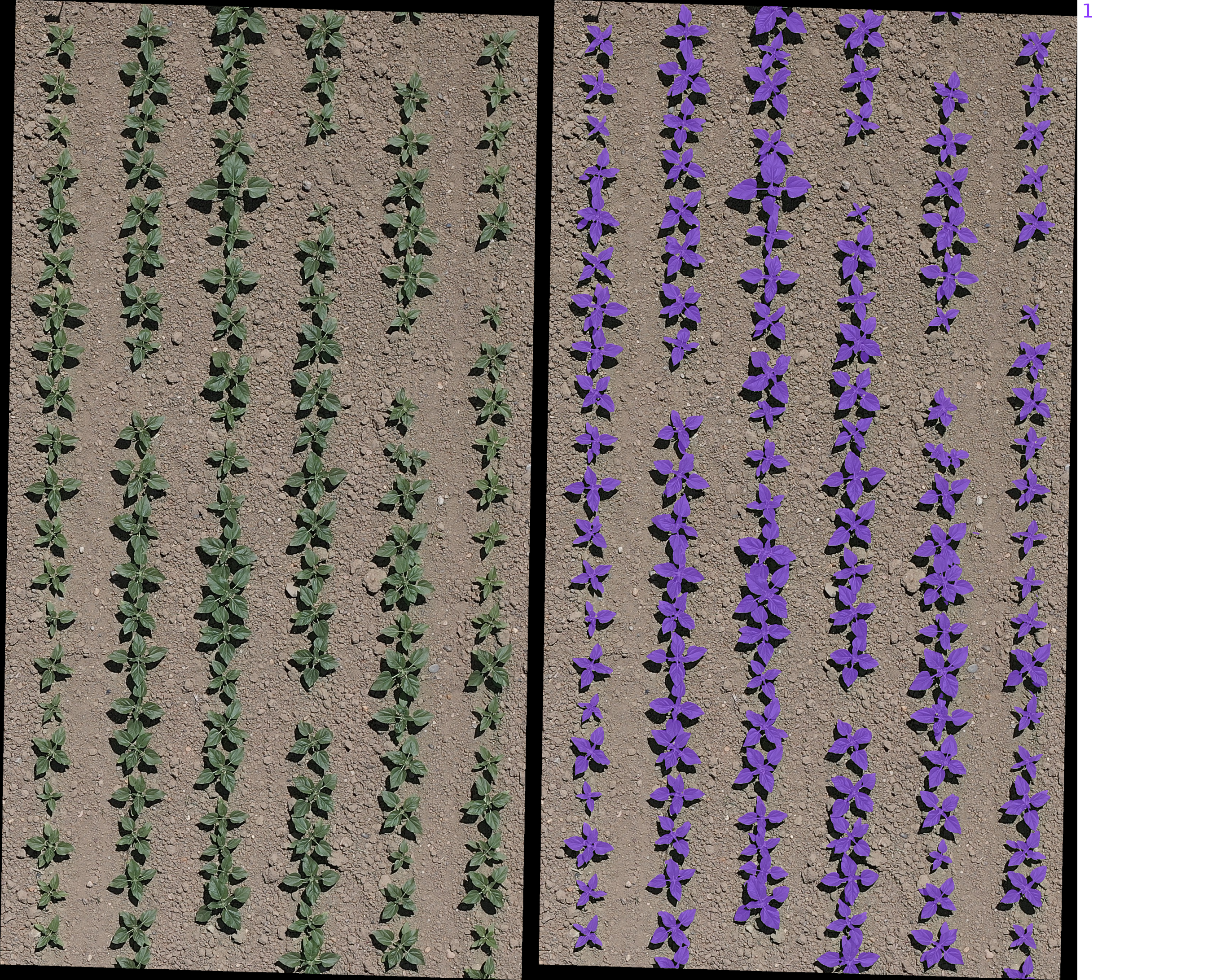
As you can notice, the prediction went well and you can access the mask tensor value as per shown in the previous cell